
By Martin Sharratt, Managing Director, AP Technologies
The ultraviolet spectrum below 240nm is a critical region for analytical science, essential for detecting key chemical compounds through absorption spectroscopy. Historically, instrument designers have relied on traditional light sources such as deuterium and mercury lamps. While functional, these technologies come with significant operational limitations: they are typically bulky, fragile, require high operating voltages and need a warm-up period to achieve a stable output. Furthermore, their use of hazardous materials such as mercury presents environmental and regulatory challenges.
Solid-state UV LEDs have long promised a better alternative, offering a smaller footprint, greater robustness, and instant-on functionality. However, fabricating high-performance LEDs in the far UV-C range using conventional semiconductor alloys has been a formidable obstacle, often resulting in low efficiency, poor reliability and high manufacturing costs. With the launch of its SF2 series, built on its proprietary Short Period Superlattice (SPSL) technology, Silanna UV has decisively overcome these obstacles. The new series is set to become the benchmark for light sources in high-value analytical applications where performance is paramount.
A New Frontier in Analytical Sensing

For designers of analytical instruments, the new 230nm far UV-C LED from Silanna UV has been engineered to accelerate the development of more precise, reliable, and compact environmental analysis instruments. The enhanced SF2 LED delivers double the output power of its predecessor with a 2x improvement in power stability versus temperature, resolving key performance compromises that undermine the accuracy and reliability of instruments used for water quality monitoring and gas detection.
Silanna UV SF2 at a Glance
| Parameter | Specification |
| Peak Wavelength | 233nm (Typ.), 230-234nm |
| Radiant Intensity | 2mW/Sr (Typ.) |
| Drive Current | 20mA (Typ.) |
| Viewing Angle | 17° |
| Package | Hermetically Sealed TO-39 |
Unlocking New Possibilities in Monitoring
The ability to accurately measure specific chemical compounds, whether dissolved in water or as a gas, is fundamental to both environmental protection and industrial process control. The Silanna UV SF2 LED has been precisely engineered for consistently accurate performance in these tasks.
- Water quality analysis: An important objective in water quality monitoring applications is the detection of nitrate (NO3) and nitrite (NO2). The SF2 series’ tight peak wavelength specification of 230-234nm is tuned for this task. This precision ensures the LED’s output aligns precisely with the absorption features of these compounds, making it an ideal 230nm light source for nitrate sensing and improving measurement accuracy.
- Gas detection: In a similar way, the 230nm wavelength is used in gas sensing instrumentation to measure concentrations of gases such as carbon dioxide (CO2) and nitric oxide (NO). The high stability and narrow spectral output of the SF2 allow for the design of more selective and reliable gas analysers.
SF2 Performance: Peak Wavelength, Radiant Intensity and Stability
The quality of the light source directly impacts an instrument’s accuracy and reliability. The new UV-C LED series delivers class-leading performance across the metrics that matter most to system designers.

- Tightly Controlled Wavelength: The new SF2 technology featuring Silanna UV’s short period superlattice (SPSL) technology has a typical spectral peak of 233nm and is specified with a narrow peak wavelength range of just 230-234nm. This is far narrower than is possible with competing technologies and enables instrument designers to be sure that they are getting the power where they need it – the peak absorption of their target.
- High radiant intensity: Radiant intensity is a critical metric for instrument designers, as it measures focused power. At a standard operating current of just 20mA, the SF2 produces a typical optical power of 0.2mW. This light is shaped by an integrated ball lens into a narrow 17° beam. This concentrates the power to achieve an exceptionally high radiant intensity of 2mW per steradian (mW/Sr). This high value ensures that more light can be efficiently coupled into an optical fibre or used to illuminate a small sample, resulting in a stronger signal-to-noise ratio and so provide more sensitive measurement capability.
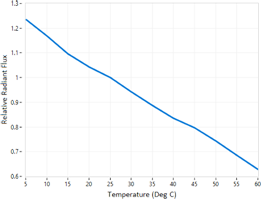 Exceptional stability: The advanced technology behind the SF2 series provides a significant improvement in temperature stability, meaning its light output (optical power) changes by only approximately 5% for every 5°C change in temperature. Performance graphs show the peak wavelength also remains highly stable, shifting by less than 1.5nm over a wide 5°C to 60°C temperature range. This thermal robustness is an important consideration when developing instruments for use in the field and ensures consistent results without the need for frequent recalibration.
- Operational efficiency: Class-leading performance is achieved at a low, standard forward current of 20mA with a typical forward voltage of 6.5V. This offers OEMs a significant advantage, since it allows for the use of simpler, lower-cost driver electronics and reduces the burden on thermal management systems, enabling more compact and cost-effective instrument designs.
 Exceptional stability: The advanced technology behind the SF2 series provides a significant improvement in temperature stability, meaning its light output (optical power) changes by only approximately 5% for every 5°C change in temperature. Performance graphs show the peak wavelength also remains highly stable, shifting by less than 1.5nm over a wide 5°C to 60°C temperature range. This thermal robustness is an important consideration when developing instruments for use in the field and ensures consistent results without the need for frequent recalibration.
Generational Leap: How the SF2 Improves on the SF1
The SF2 series represents a significant and strategic evolution from Silanna UV’s first-generation SF1 technology. This positive evolution is clear in several key performance upgrades:
- Tighter wavelength specification. The SF2 offers a peak wavelength bin of just four nanometres (230-234nm) – 2.5 times tighter than the SF1’s ten-nanometre range (235±5nm peak). This gives designers greater confidence in hitting specific absorption peaks and reduces part-to-part variation.
- Vastly increased radiant intensity. There has been a greater than 10x increase in typical radiant intensity, jumping to 2mW/Sr in the SF2.
- Enhanced stability. The SF2 technology doubles the temperature stability over the previous generation. This translates directly to more reliable and repeatable measurements.
A Clear Advantage in a Competitive Field
When selecting far UV-C LEDs, designers often have to make compromises. The SF2’s key differentiator is the unique combination of high, focused radiant intensity (2mW/Sr) achieved at an efficient and industry-standard 20mA drive current. This balance of focused power and operational efficiency, coupled with the reliability of its hermetic package, positions it as a superior component and the obvious choice for designers of high-performance systems for air and water quality analysis.
Engineered for Long-Term
Analytical instruments are often expected to operate flawlessly for years in demanding environments. Recognising this, Silanna UV has launched the SF2 in an industry-standard, hermetically sealed TO-39 metal can. This robust construction offers superior protection against environmental factors like moisture and dust compared to common surface-mount packages.
Partner with the Experts at AP Technologies
Component selection requires expertise. At AP Technologies, we are a technical partner committed to helping you navigate the inherent complexities and their practical implications. We have the knowledge to help you harness the full potential of this technology, ensuring you can develop more competitive, reliable, and higher-performing instrumentation.
The Silanna UV SF2 is more than an incremental update; it is an enabling technology poised to accelerate the development of the next generation of analytical instruments. Visit the product page on the AP Technologies website to find more detail and download datasheets.
AP Technologies will be exhibiting at Instrumentation Live 2026. The free, one-day exhibition will take place on 18 March 2026 at the National Conference Centre (NCC) in Birmingham, bringing together engineers, technical specialists and industry suppliers from across sectors.